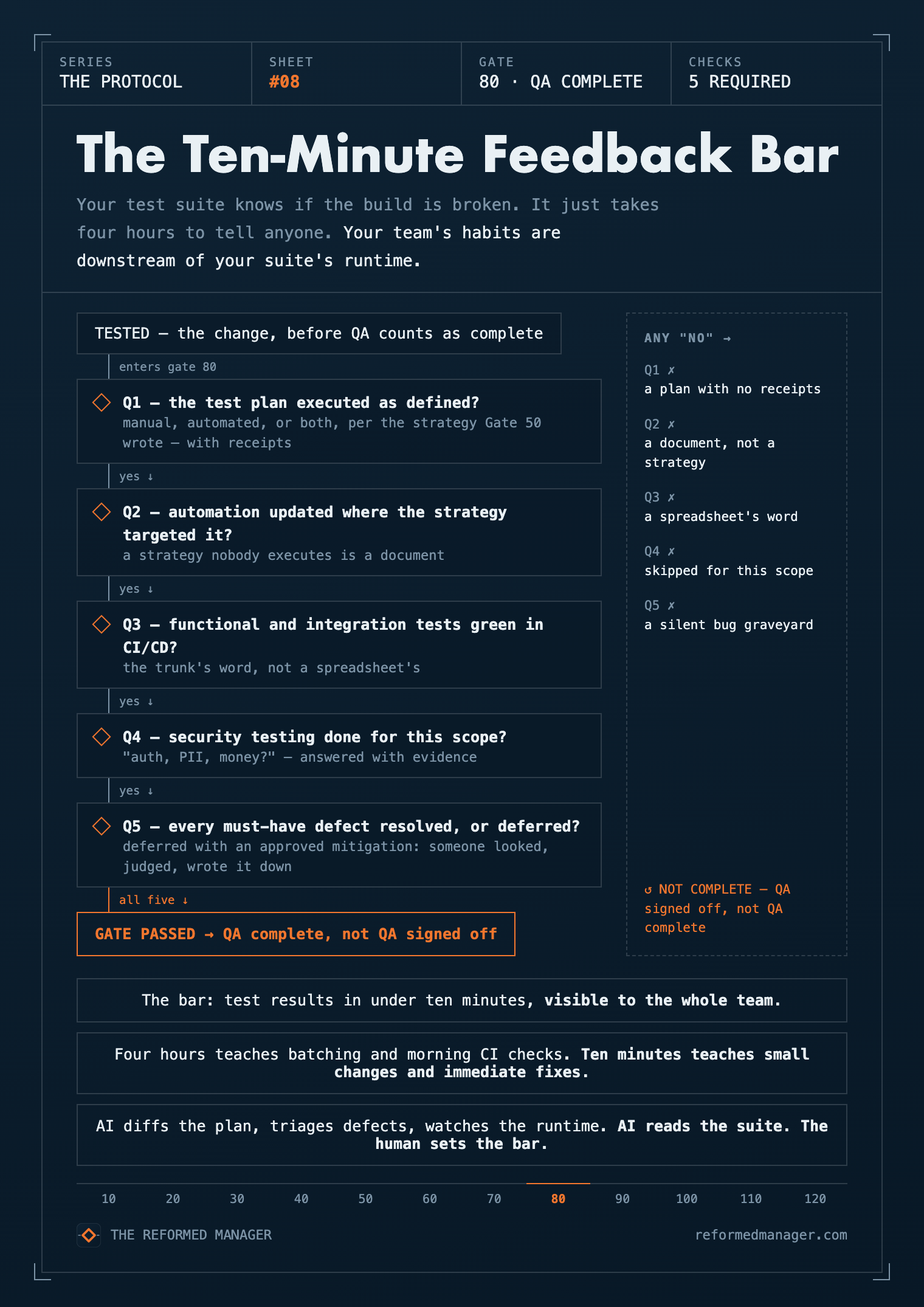
Your test suite knows if the build is broken. It just takes four hours to tell anyone.
Think about how strange that is. Somewhere in your pipeline, the answer already exists — this change is fine, that one broke checkout — and the organization pays salaries while the answer sits in a queue. By the time the verdict arrives, the developer is three commits deep into something else, the context is gone, and the red result lands on a person who has to archaeologize their own morning. The information was cheap to produce. The latency is what made it expensive.
Gate 80 in my system is QA Complete, and the bar comes from DORA’s continuous-delivery research: test results in under ten minutes, visible to the whole team. Most teams read that as an infrastructure goal. It’s bigger than that — it’s a behavioral one.
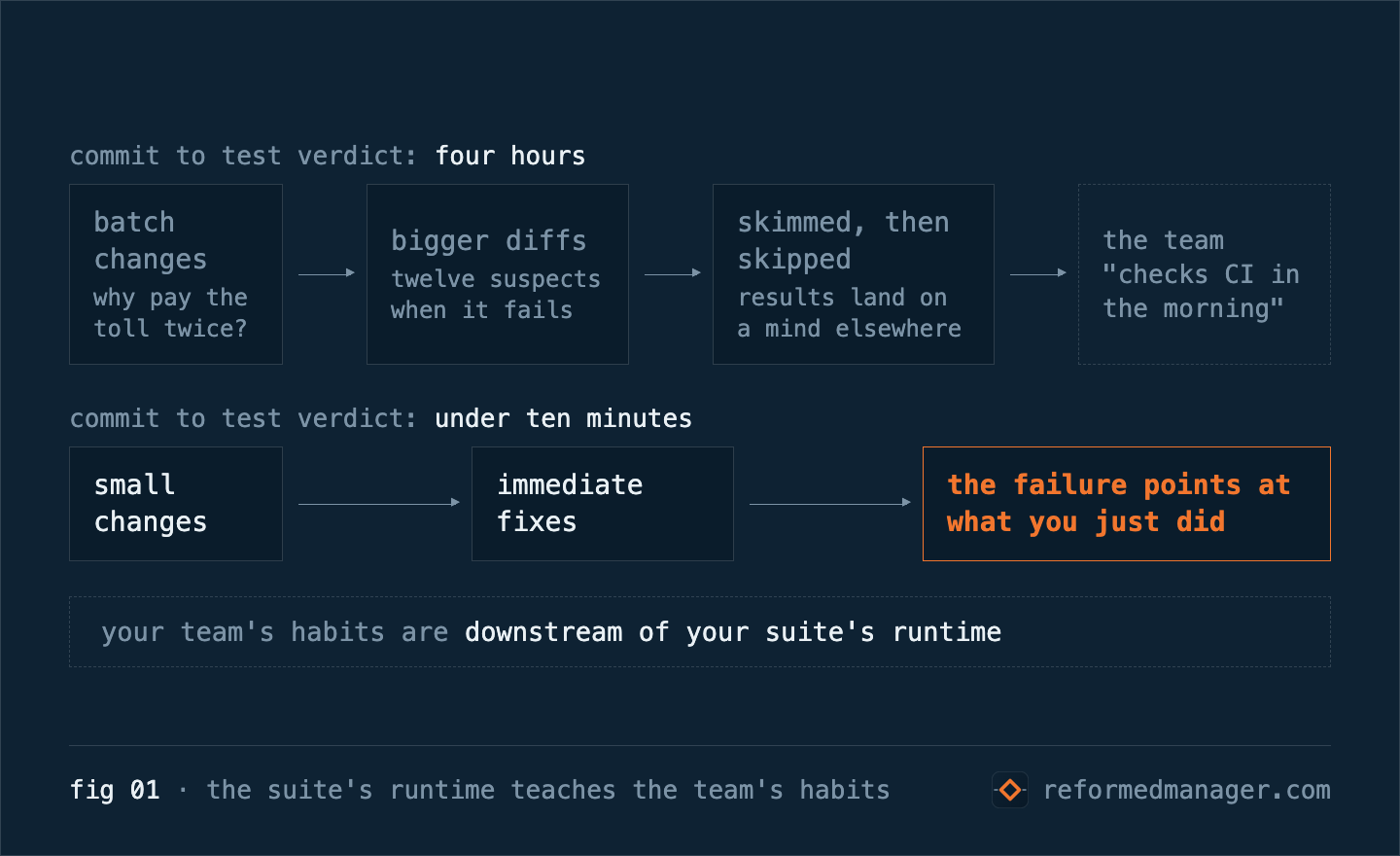
What does a four-hour suite teach a team?
Feedback latency shapes how people code. Walk the chain once and you can’t unsee it. A four-hour suite teaches developers to batch changes — why pay the toll twice? Batched changes mean bigger diffs. Bigger diffs mean harder reviews and, when something fails, twelve suspects instead of one. Waiting means context-switching away, so results land on someone who’s mentally elsewhere, and get skimmed, then skipped. Before long you have a team that “checks CI in the morning.” Nobody decides to have a bad testing culture. They inherit it from a slow pipeline. Run the chain the other direction and it compounds just as hard: ten-minute feedback teaches small changes, immediate fixes, failures that point at the exact thing you just did. Your team’s habits are downstream of your suite’s runtime.
Who actually sees the results?
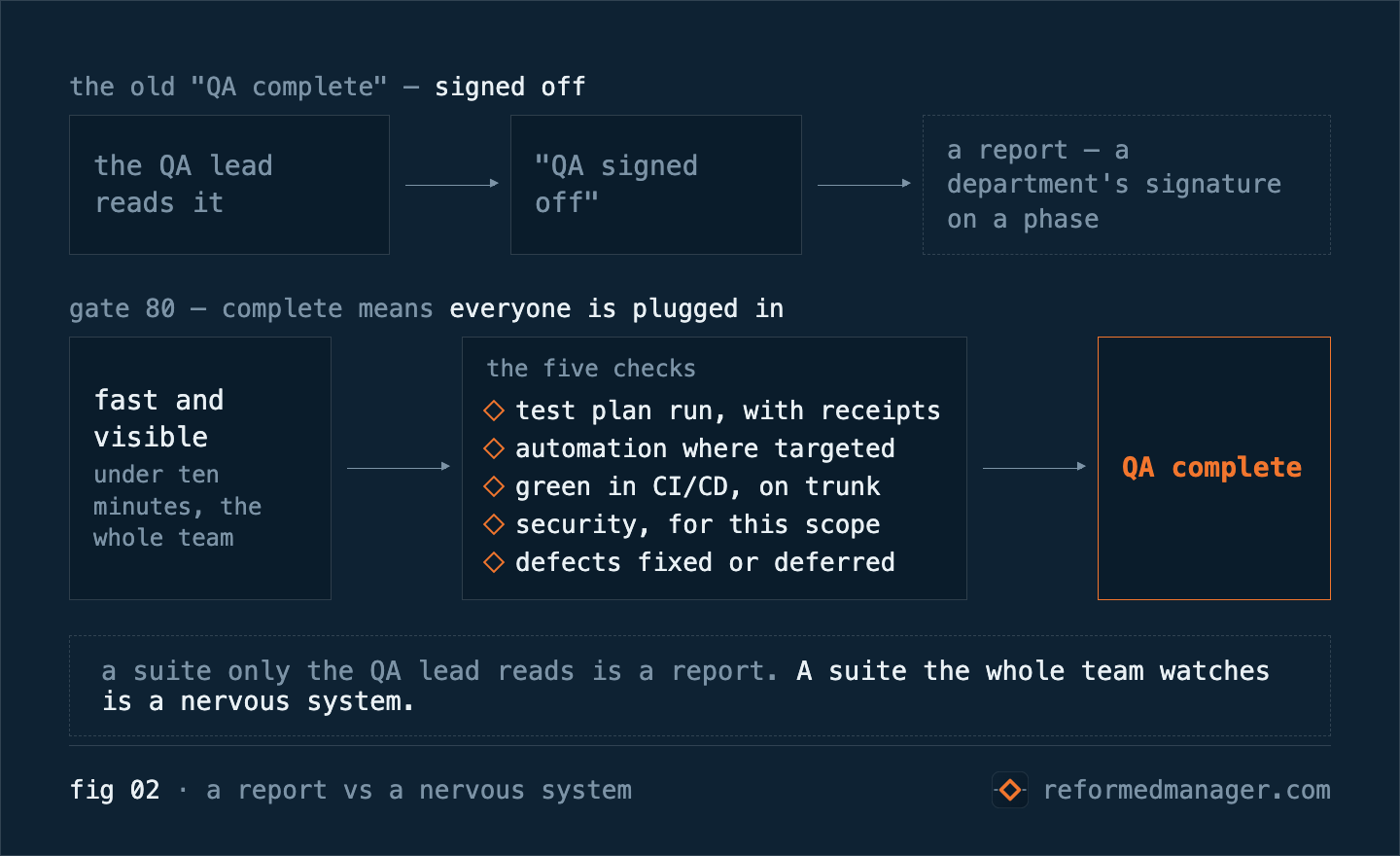
The second half of the bar is quieter and just as important: visible to the whole team. A suite only the QA lead reads is a report. A suite the whole team watches is a nervous system. So “QA complete” doesn’t mean “QA signed off” — a department’s signature on a phase. It means the feedback loop runs fast and everyone is plugged into it. Quality stops being someone’s job title and becomes the team’s shared signal.
What does Gate 80 check?
None of that excuses skipping the basics. Five checks, each with the clause that makes it real:
- The test plan executed as defined — manual, automated, or both, per the strategy Gate 50 wrote. With receipts.
- Automation updated where the strategy targeted it. A test strategy nobody executes is a document, not a strategy.
- Functional and integration tests green in CI/CD — the trunk’s word, not a spreadsheet’s.
- Security testing done for this scope — the thirty-second “auth, PII, money?” question from Gate 50, now answered with evidence.
- Every must-have defect resolved — or deferred with an approved mitigation. Deferral-with-a-decision is engineering: someone looked, judged, wrote it down. A silent bug graveyard is not.
Your team’s habits are downstream of your suite’s runtime.
What happens when AI writes the tests?
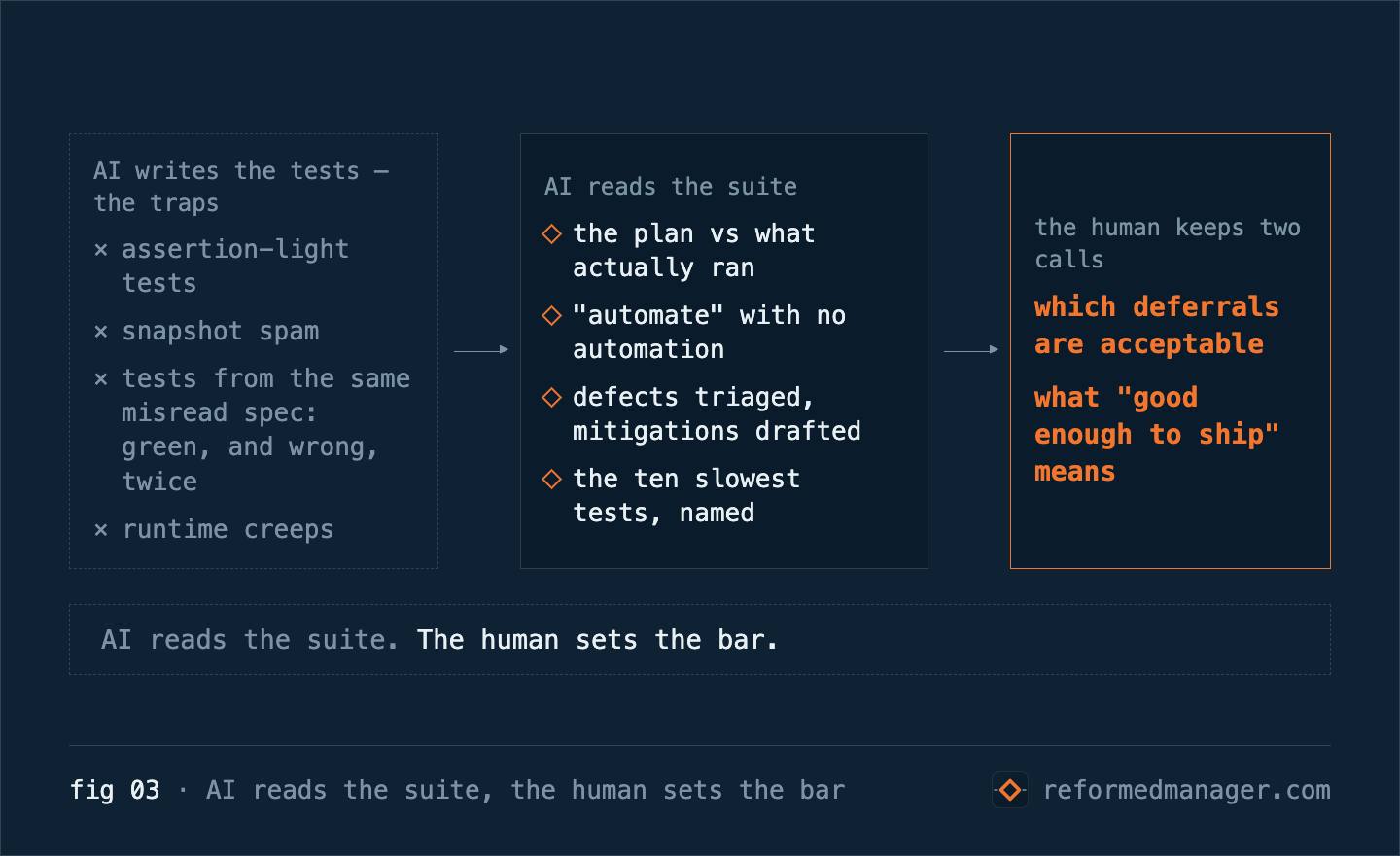
AI writes tests now too, and that cuts both ways. The good news is real: coverage for changed logic is cheaper than it has ever been. The trap is subtler: coverage inflates while meaning doesn’t. Assertion-light tests that execute code without checking it. Snapshot spam that fails on every change and informs on none. And the sharpest version — tests generated from the same misread spec as the code, proving the wrong thing works, in duplicate. (Protocol #5 warned that a vague spec becomes confidently wrong software overnight; it becomes confidently wrong tests on the same schedule.) Meanwhile AI-driven code volume grows the suite, runtime creeps, and feedback slows at exactly the moment it most needs to be fast. The ten-minute bar is what keeps all of this honest — because a slow suite gets ignored, and an ignored suite is no suite at all.
So what does AI do at this gate? Four jobs. It diffs the test plan against what actually ran — coverage promised versus coverage executed. It flags where the Gate 50 strategy said “automate” and no automation landed. It triages the defect list into must-haves and defer-candidates and drafts the mitigation note for each deferral — the paperwork that makes deferral a decision instead of a shrug. And it watches the runtime trend, naming the ten slowest tests for surgery before the suite crosses the line from asset to ambient noise. The human keeps the two calls that matter: which deferrals are acceptable, and what “good enough to ship” means this release. AI reads the suite. The human sets the bar.
Isn’t this the QA lead’s job?
No. The suite’s runtime is a budget, and only the engineering leader has standing to spend it. Nobody else in the org can trade feature time for feedback speed and make it stick. And it’s 20% that brings 80% of the result: a fast, watched suite is the slice of QA investment that buys the team’s trust that the pipeline tells the truth, and the org’s trust that green means go.
Ten minutes is a bar, not a law of physics. Big systems earn it in layers — a fast suite on every commit, deeper integration and security suites staged behind it. The discipline is the direction: feedback fast enough to act on, and visible enough that the whole team acts on it.
That’s Protocol #8. Gate 90 — Release Candidate Ready, where the rollback gets rehearsed before the rollout — is next. Four gates to go.