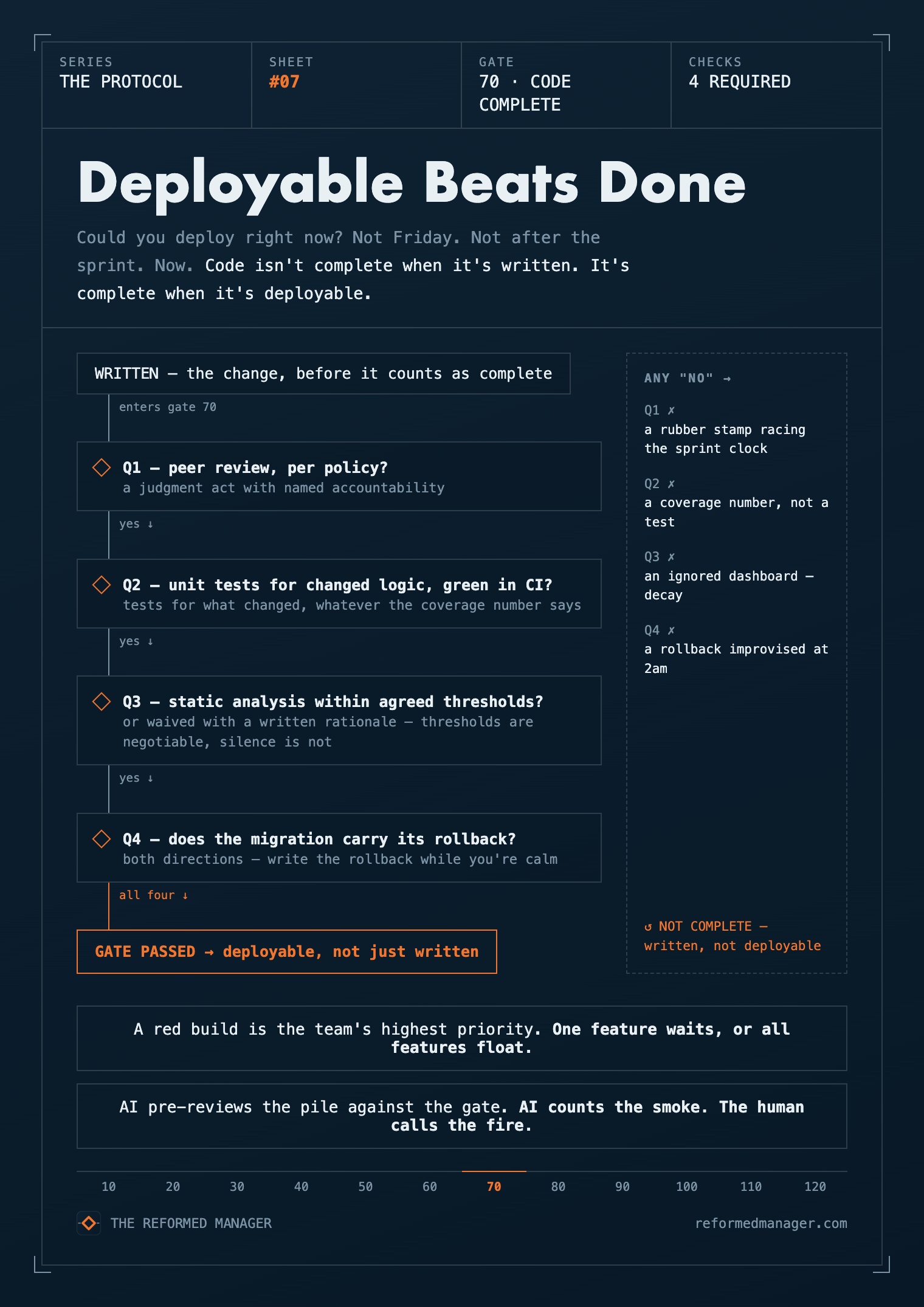
Could you deploy right now? Not Friday. Not after the sprint. Now. That one question is the whole gate.
Ask it of any team in your org and listen to the texture of the answer. A healthy team answers with a fact: “yes, trunk’s green, last deploy was this morning.” An unhealthy team answers with a story: “well, almost — once the flaky test settles, and after someone’s branch merges, and we’d want to check the migration first…” The moment the answer needs three clauses, you don’t have deployable software. You have software with an alibi.
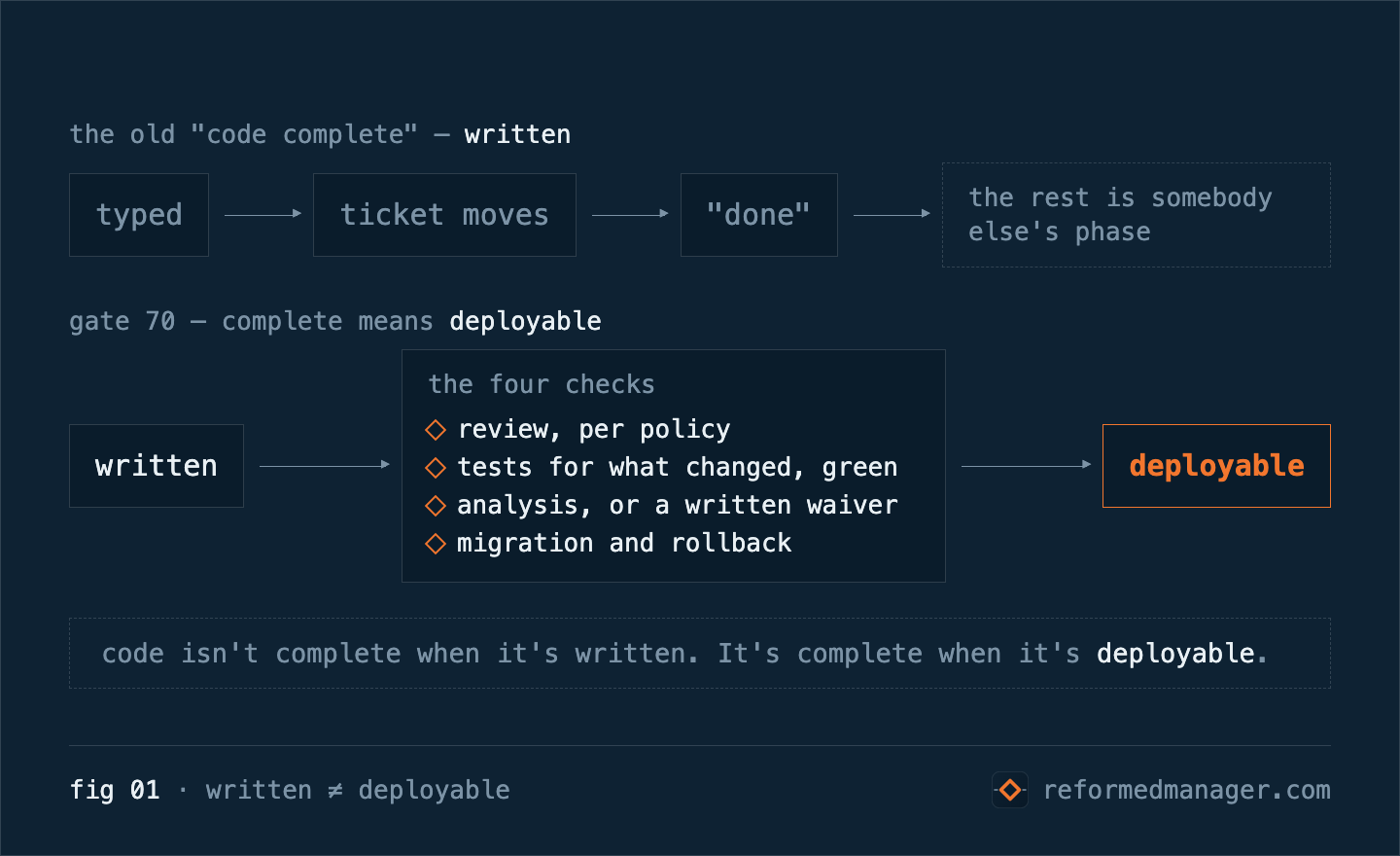
Gate 70 in my system is Code Complete, and the name carries decades of bad history, because “code complete” used to mean written. The developer finished typing; the ticket moved columns; done. Everything after that — integration surprises, the broken build, the migration nobody rehearsed — was somebody else’s phase. Gate 70 redefines the words: code isn’t complete when it’s written. It’s complete when it’s deployable. That’s the DORA continuous-delivery bar, and it comes with a priority rule attached, the most counterintuitive line in the whole gate system: deployability is prioritized over new features. A failing build or test is the team’s highest priority. Not “after this ticket.” Highest.
What does Gate 70 check?
The floor checks are the ones you’d expect, each with a clause that keeps it honest. What comes first? Review. Then tests, static analysis, and the database.
- Peer review, per policy. The policy part matters: review is a judgment act with named accountability, not a rubber stamp racing the sprint clock.
- Unit tests for the new and changed logic, green in CI. Tests for what changed, whatever the coverage number says.
- Static analysis within agreed thresholds — or waived with a written rationale. The waiver clause is the point: thresholds are negotiable, silence is not. “We accept this finding because X” is engineering; an ignored dashboard is decay.
- Database changes carry the migration and the rollback. Both directions. The rollback you don’t write calmly today is the one you’ll improvise at 2am in an incident channel.
But what about the roadmap?
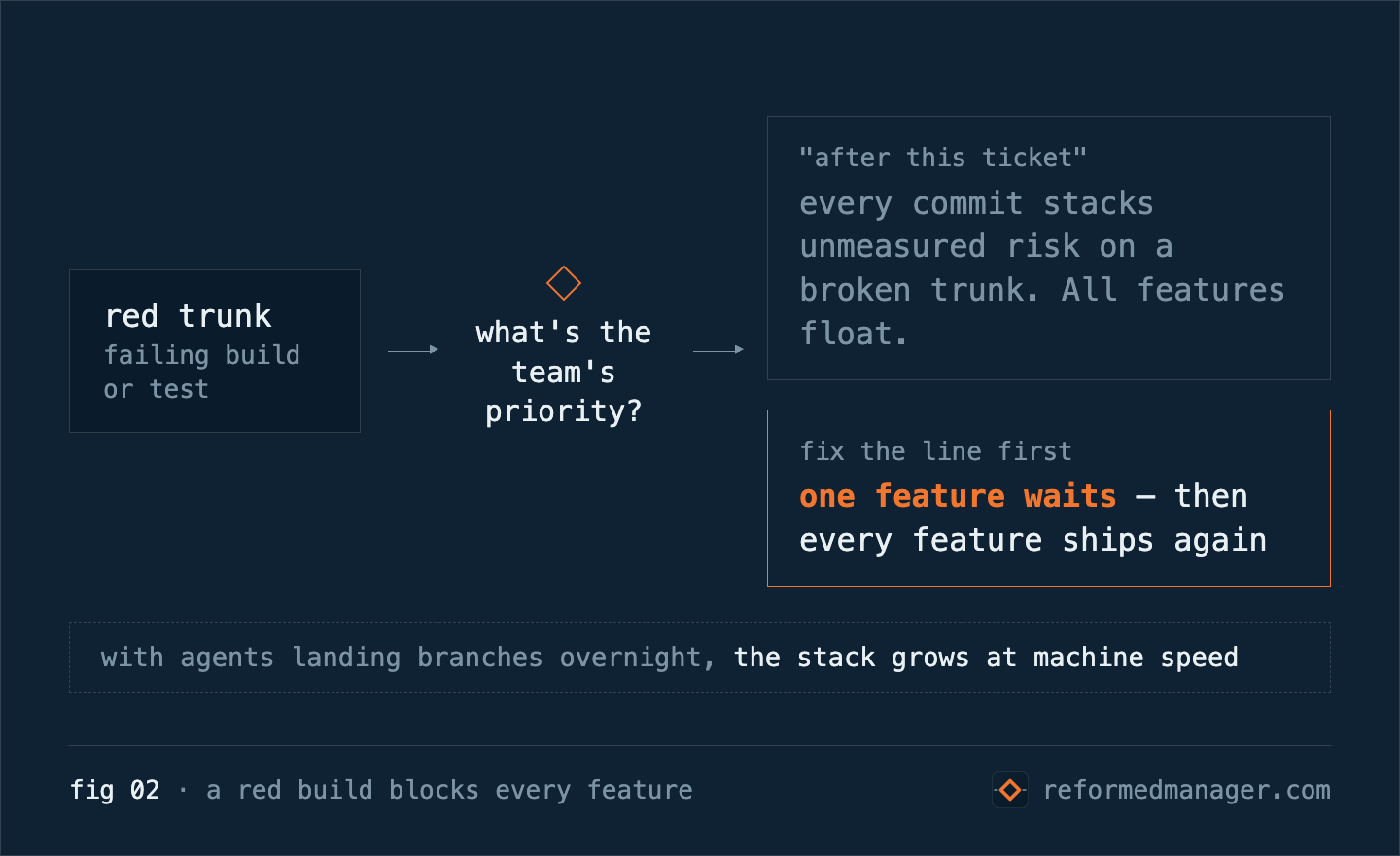
Every roadmap owner who reads “deployability over new features” feels the same twitch: we can’t afford to stop the line for a build. Walk the logic one step further and the twitch resolves. A red build doesn’t block a feature. It blocks every feature. Each commit that lands on a broken trunk adds risk nobody has measured, stacked on risk nobody has measured. Fixing the line first is the only thing keeping the roadmap’s dates honest. One feature waits, or all features float on an unknown.
What did AI change here?
Now add AI. No gate feels it harder than this one. AI made code cheap. It didn’t make software cheap. The gap between those two sentences is Gate 70. Code volume is exploding: more PRs, bigger diffs, agents landing branches overnight. Review became the bottleneck, and “works on my branch” now multiplies at machine speed. What survives that volume is the objective floor: the trunk is green or it isn’t; the deploy works or it doesn’t. A green trunk doesn’t care who — or what — wrote the code. That’s why the red-build rule matters more now: ten agents landing code on a broken trunk is compounding unknowns at a rate no retro can unwind. Stop-the-line was a good discipline at human speed. At machine speed it’s a survival trait.
How do you keep up with the review pile?
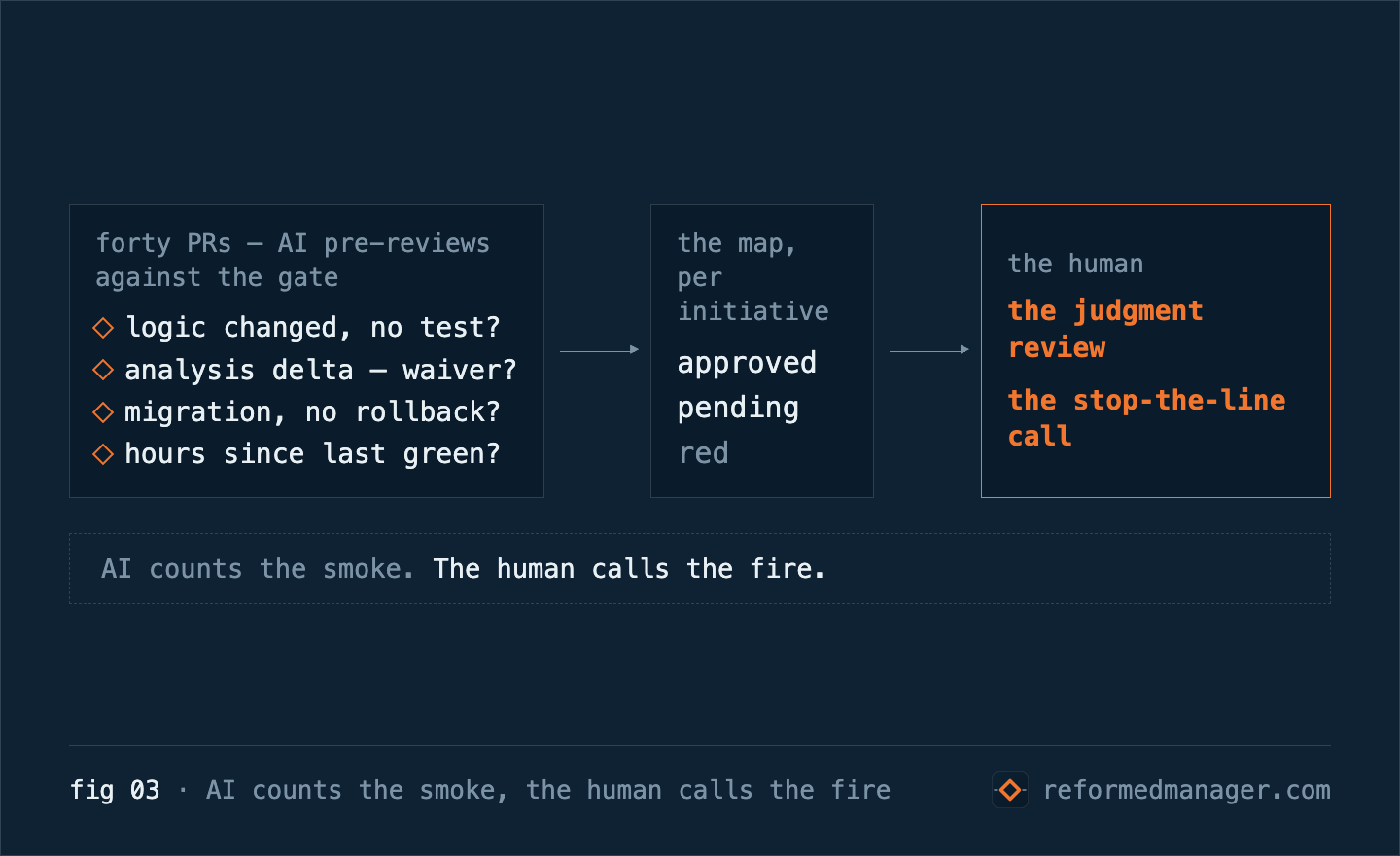
So put AI on the bottleneck itself. Nobody should triage a forty-PR pile by scrolling. AI pre-reviews the pile against the gate: Which PRs changed logic without touching a test? What did the static-analysis delta do — and is there a written waiver? Which migration has no rollback? How many hours since the trunk was last green, and which merge broke it? It drafts the per-initiative review summary — approved, pending, red — so the humans start from a map. What stays human is the part that was always the point: the judgment review — is this the right change, does it fit the architecture, would I want to maintain it — and the stop-the-line call. AI counts the smoke. The human calls the fire.
A green trunk doesn’t care who — or what — wrote the code.
Isn’t this the tech lead’s problem?
The leader owns this gate because deployability is a leadership metric wearing a technical costume. A deployable trunk is your org’s option value — you can respond to anything today: the incident, the opportunity, the executive “can we ship it this week?” Undeployable software is inventory: effort spent, value unrealized, risk accruing. When I report health upward, “we can deploy on demand” says more than any velocity chart.
None of this is heroic. Deployability is put-your-ass-in-the-chair work: unglamorous, daily, non-negotiable. Fix the build before the feature. Write the rollback while you’re calm. Review like your name is on it, because it is. Done that can’t ship is a story you tell yourself. Deployable is a fact.
That’s Protocol #7. Protocol #8 is Gate 80, QA Complete, where test results land in under ten minutes, in front of the whole team. Five gates to go.