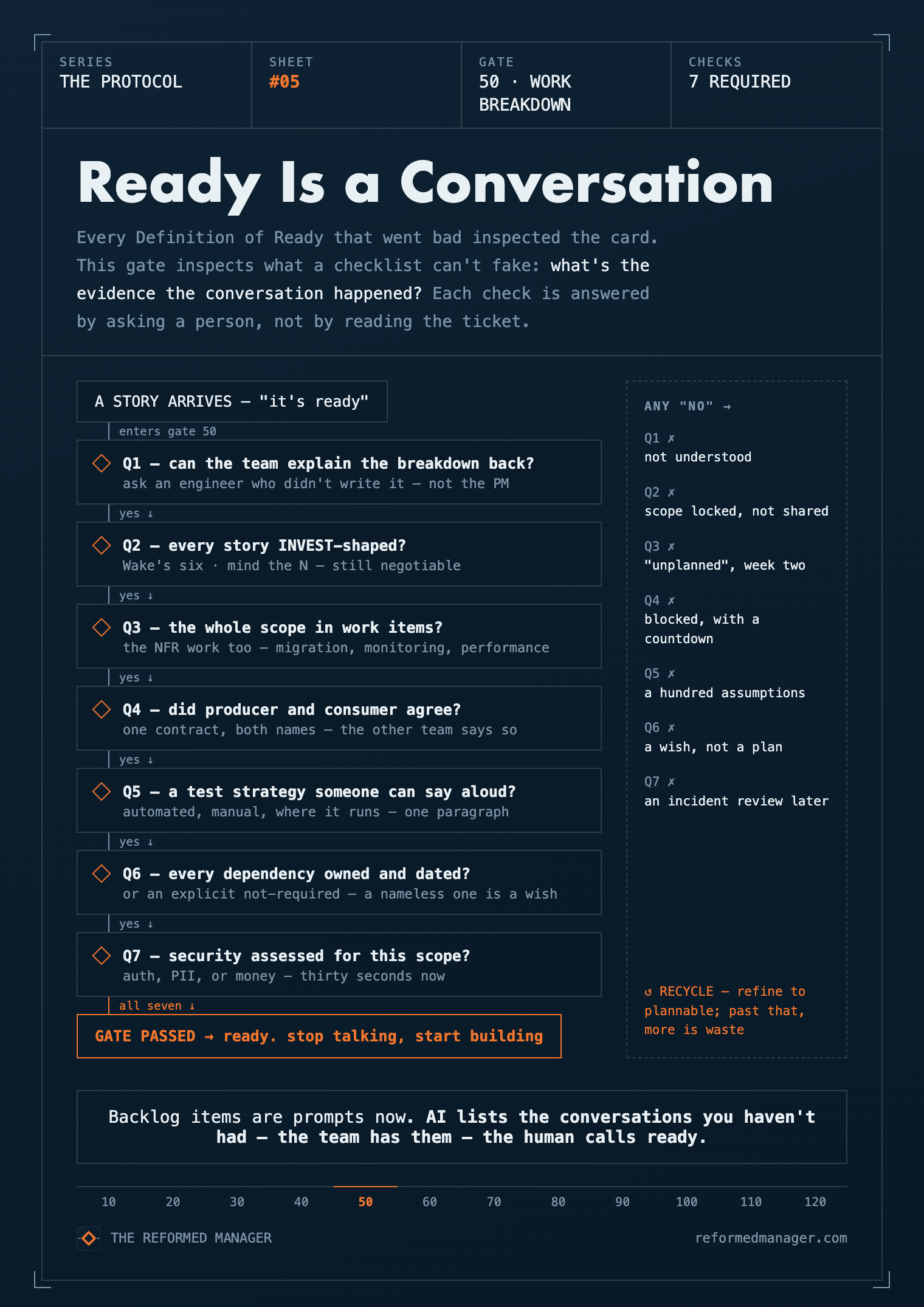
“Ready” isn’t a checklist. It’s a conversation that happened.
The Scrum Guide — the document every sprint on earth claims descent from — gives Done a formal definition and Ready none. The word appears once: backlog items that can be finished within one sprint are “deemed ready for selection,” and that readiness is the output of refinement, which the Guide defines as breaking items down and defining them further. No fields. No sign-offs. No template. And yet a Definition of Ready is standard issue on most teams, and the fights about it are standard issue too.
Readiness has two classic ways to hurt you. The first is pulling vibes: a one-line ticket, “we’ll figure it out mid-sprint,” and by Thursday the story has tripled and the sprint goal is fiction. The second hurts slower: a Definition of Ready so rigid that nothing gets in without six fields, three sign-offs, and a diagram — and the team stops talking and starts filing paperwork at each other.
Gate 50 in my system is Work Breakdown Complete — the team’s explicit Definition of Ready — and I’ll put the prosecution’s case first, because it’s strong and it’s aimed at exactly this gate. Scrum.org’s own trainers have watched DoR curdle. Joanna Płaskonka, writing there in 2023, lists the warning signs: planning paralysis; silo blame — the PM “didn’t make it ready,” so the team “can’t work”; and the deadliest mutation, “once it’s ready, no changes allowed.” A checklist meant to protect the sprint becomes a wall between the people who write the tickets and the people who work from them. Barry Overeem, from the same school, answered “why isn’t DoR in the Scrum Guide?” in 2016 with one line: because it is — “not as a checklist but as an activity: backlog refinement.”
The prosecution is right about the failure mode and wrong about the remedy. The remedy isn’t no gate. It’s a gate that inspects something a checklist can’t fake.
What does Gate 50 actually check?
Start with the original story doctrine — Ron Jeffries’ card, conversation, confirmation, from 2001. The card was never the spec. The requirement lives in the conversation between the people who want the thing and the people who build it, pinned down by a confirmation you can test. Every Definition of Ready that went bad went bad the same way: it inspected the card. Six fields, filled. Paperwork can be produced by one person typing alone at midnight. A conversation can’t.
So Gate 50 doesn’t ask “are the fields filled in?” It asks: what’s the evidence the conversation happened? The checklist is the receipt for a conversation, not a substitute for it — and that one distinction is the difference between a gate and a wall.
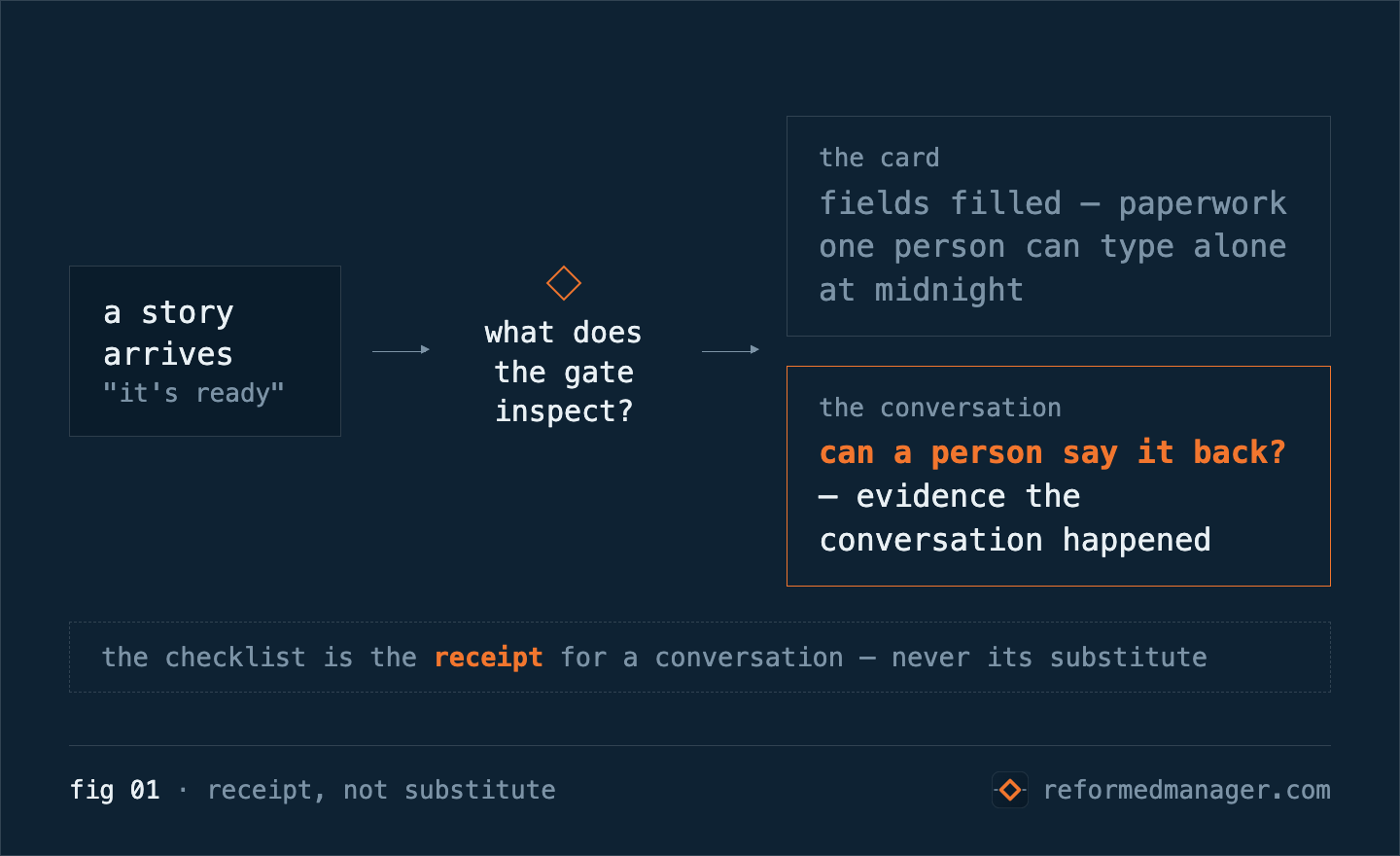
(By the way, this is the gate where the checklist is most tempting, because adding a field looks like rigor and costs nothing. It costs exactly this: every field you add is one more thing a person can fill in alone at midnight.)
What counts as evidence?
Every check below is run the same way: not by reading the ticket, but by asking a person. If the ticket says it and the engineer can’t say it back, the answer is no.
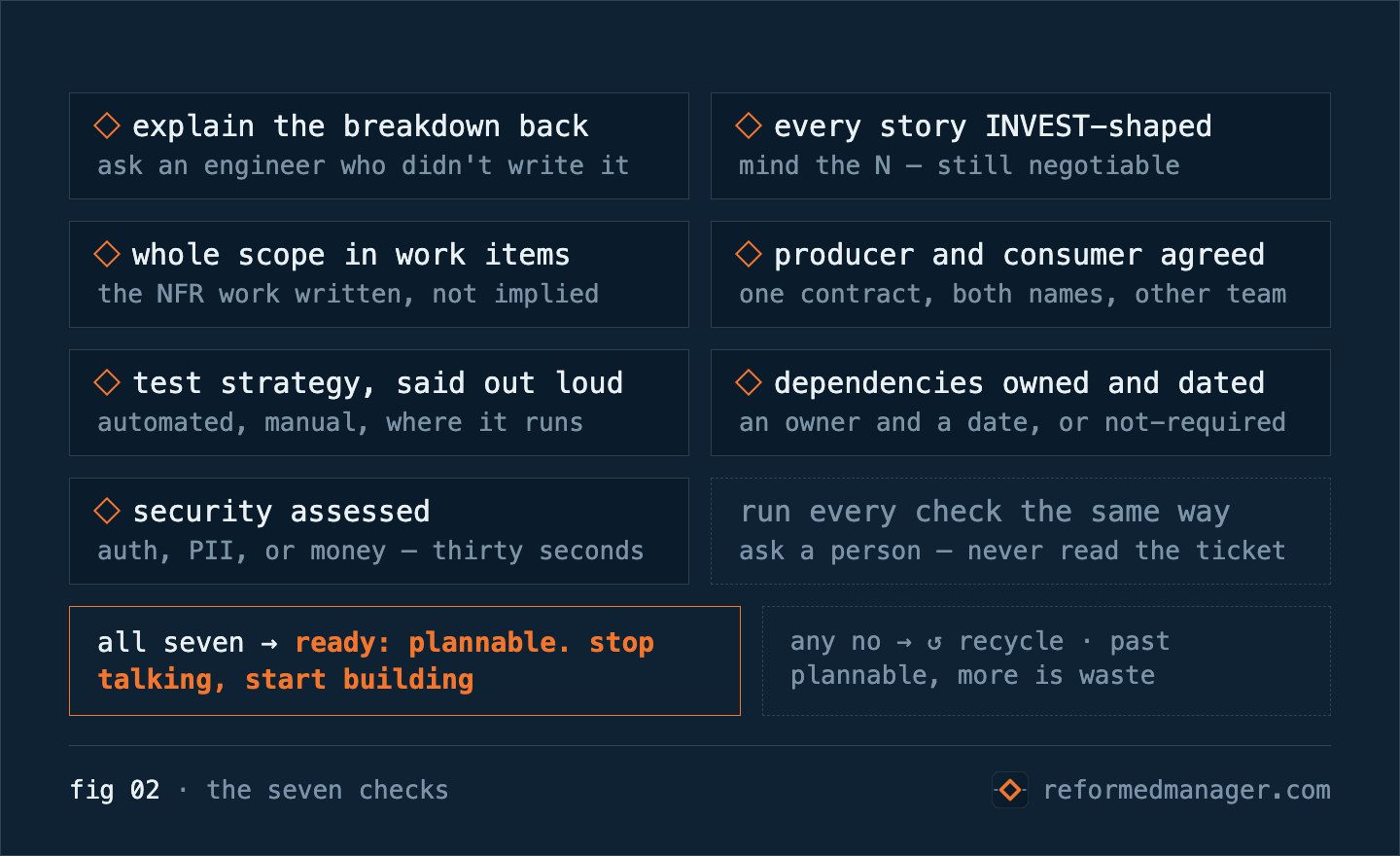
- Can the team explain the breakdown back? Pick an engineer — not the one who wrote it — and ask what story three is for and why the split falls where it does. If the answer needs the PM in the room, you have documentation, not understanding.
- Is every story INVEST-shaped? Bill Wake’s 2003 checklist: independent, negotiable, valuable, estimable, small, testable. Mind the N. A ready story is still negotiable — readiness locks in shared understanding, not scope. That single letter is the anti-phase-gate clause, written into the doctrine a decade before anyone weaponized a DoR.
- Is the whole scope in work items — including the non-functional part? Ask where the migration is. Where the monitoring is. Where the performance work is. Unwritten NFR work doesn’t vanish; it comes back in week two wearing a badge that says “unplanned.”
- Did the API producer and consumer actually agree? Two teams, one contract, both names on it — and you ask the other team. “We’ll align during the sprint” is a blocked story with a countdown attached.
- Can someone say the test strategy out loud? What’s automated, what’s manual, where it runs. One paragraph beats a hundred assumptions.
- Does every external dependency have an owner and a date? Or an explicit “not required.” A dependency without a name on it is a wish.
- Was security assessed for this change’s scope? Thirty seconds of “does this touch auth, PII, or money?” now, or an incident review later.
And the bound on all of it — the clause that keeps Gate 50 from becoming the wall — comes from Ian Mitchell, a Scrum.org trainer who uses a Definition of Ready and says so: refine until the sprint can be planned, and “any more refinement than that is waste, while any less will not be enough.” Ready is a threshold, not a ceiling. Past plannable, stop talking and start building.
The checklist is the receipt for a conversation, not a substitute for it.
What changed this year?
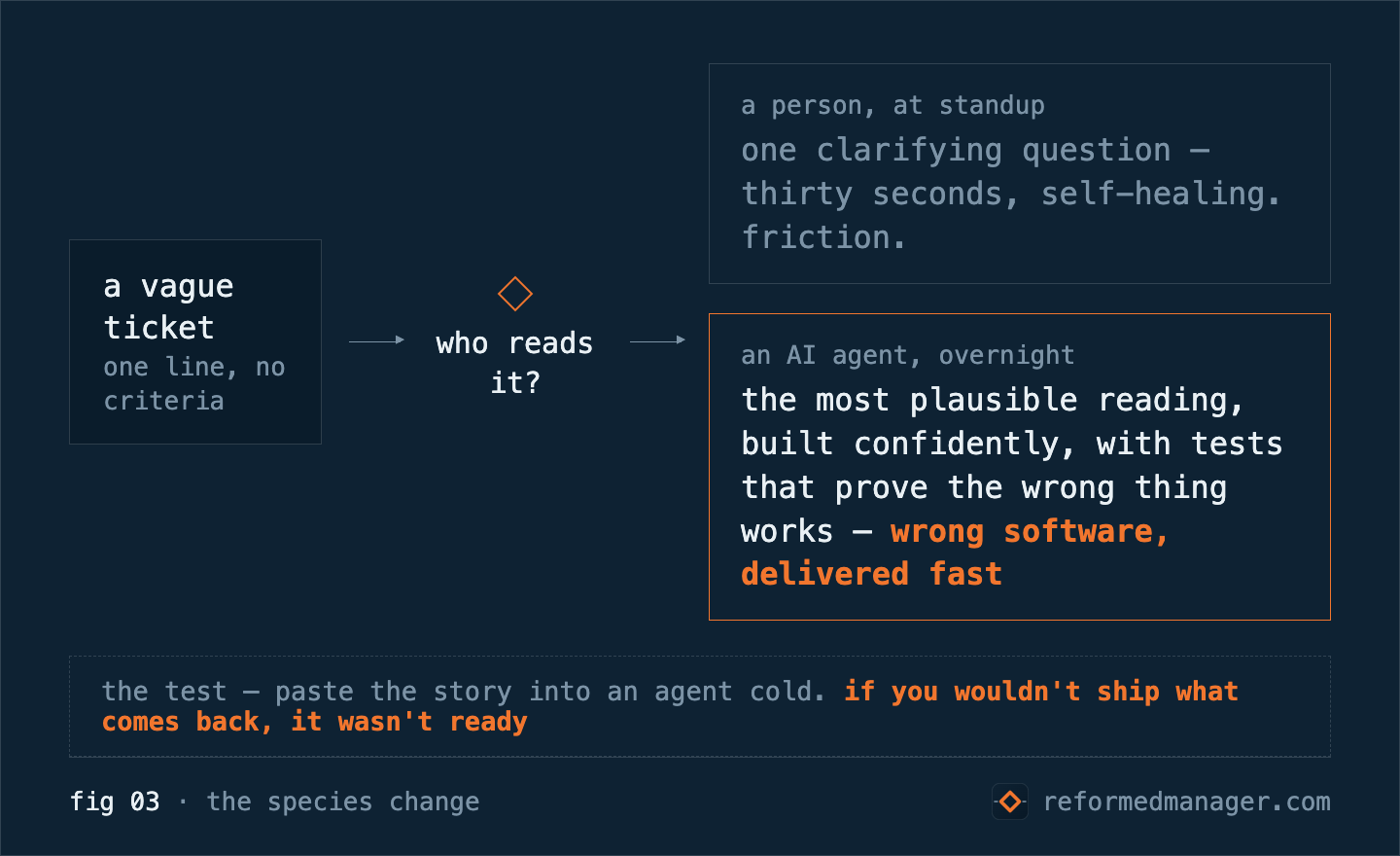
Now the amplifier — and on this gate it doesn’t scale the problem, it changes its species. Backlog items are prompts now. A vague ticket used to cost a clarifying question at standup: thirty seconds, mildly annoying, self-healing. Hand the same ticket to an AI agent and it doesn’t raise its hand. It implements the most plausible interpretation, confidently, overnight, with tests that prove the wrong thing works. Unready used to be friction. Now it’s wrong software, delivered fast.
Zoom out and the gate hasn’t moved: shared understanding before the work starts. Zoom in and “ready” has acquired a machine reader. The test is literal — paste the story into an agent cold and see what it builds. If you wouldn’t ship what comes back, the story wasn’t ready.
Where does AI fit — and where can’t it?
The augmentation runs the same pattern in reverse. Before refinement, I hand AI the initiative and the gate: check every story against INVEST, flag missing acceptance criteria, find the API contracts with only one team’s name on them, list dependencies without owners, mark where the test strategy is silence. It returns the gaps as questions — “Story 4 says ‘export’: CSV, PDF, or both? Who owns the payments-API change? What’s the rollback if the migration fails?” — and refinement starts from a gap list instead of a blank stare. That’s the 20% of preparation that buys 80% of the meeting.
What AI cannot do — and this is the line — is have the conversation. It is remarkably good at telling you which conversations you haven’t had. The team has them. The human calls ready or recycle.
Why does the engineering leader own this gate?
Because carryover is where unready work sends the bill, and the bill lands on the one thing a Director owns upward: the forecast. Every story that triples mid-sprint is a forecast quietly broken, and after enough quarters of that, the org stops planning around your forecasts at all — which is the moment you stop being in the room for the decisions that matter. Refinement looks like a team ritual. It’s your credibility, built weekly.
One honesty note. Nobody has published a defensible number linking unready work to carryover. The best evidence is Ken Power’s 2014 experience report from Cisco, and it claims only that not having a definition of ready “can seriously impede the flow of work through your system.” One company, no control group. It matches every carryover retro I’ve sat in, and I still won’t dress it up as data.
So the leader’s move isn’t a better template. It’s inspection. Once a month, pick one team and one engineer, and ask for the explain-back. Five minutes. Then make refinement weekly, not a gate the team binges the night before planning. I’d rather inspect the conversation than audit the wreckage.
The job a ticket was hired to do was never “hold fields.” It was to carry shared understanding from the people who want the thing to the people who build it. Ready is that transfer, completed. Refine now, or explain later. Easy choice, hard sprint. Hard choice, easy sprint.
That’s Protocol #5. Next is Protocol #6 — Gate 60, Sprint Commitment — where the team commits to a goal and forecasts a scope, and the gap between those two verbs is the whole story. Seven gates to go.