AI didn’t make my team faster. It made us faster at shipping the wrong thing — until we fixed Gate 10.
Nobody warned us about this when the AI wave hit engineering: it’s an amplifier, not a cure. Point it at a healthy system and it accelerates you. Point it at a messy one and it amplifies the mess — faster than you could have managed on your own. That’s not a hot take; it’s DORA’s 2025 finding, close to verbatim: AI is an amplifier, and the greatest return comes not from the tools but from the underlying system — clarity of workflows, quality of the platform, alignment of teams. Magnify a healthy org and AI multiplies it. Magnify a confused one and you just ship confusion at scale. (It doesn’t make the strong immune, either — even mature teams get burned when they let speed outrun their gates. Amplifier, not armor.)
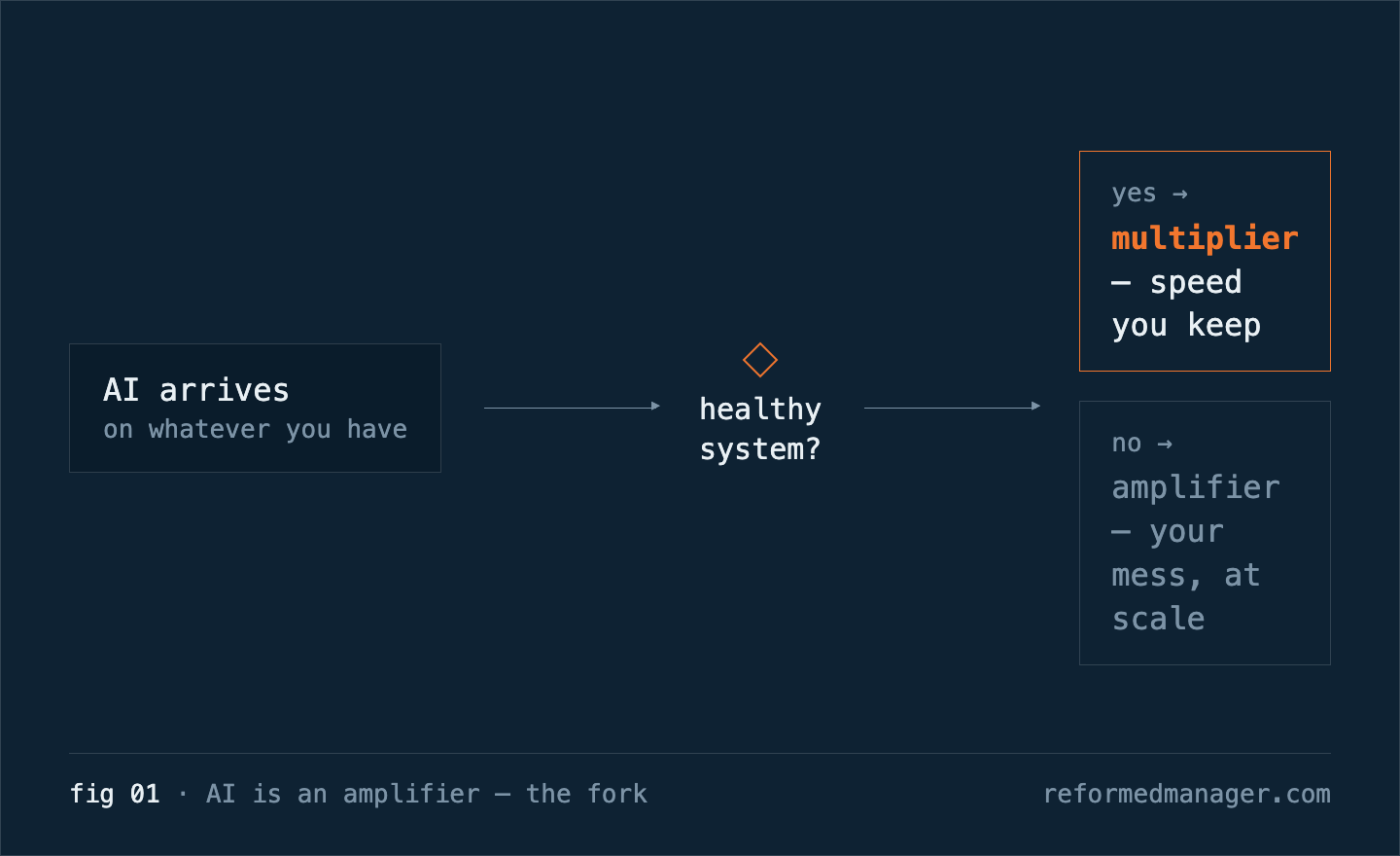
So the model isn’t the variable. Your system is. And the first place a system is healthy or sick is the gate most teams don’t even have — the one before the work is allowed in.
Where does shipping the wrong thing actually start?
I learned this the way most of us do: by catching myself in the act. Deep in a design discussion, walking the architecture, sequencing the work — and a quiet voice says, you’re solutioning without the end game in mind. We were building. We just hadn’t agreed on what “done” was supposed to achieve. AI makes that failure worse, not better, because it will happily generate a beautiful solution to a question nobody asked.
What does Gate 10 actually check?
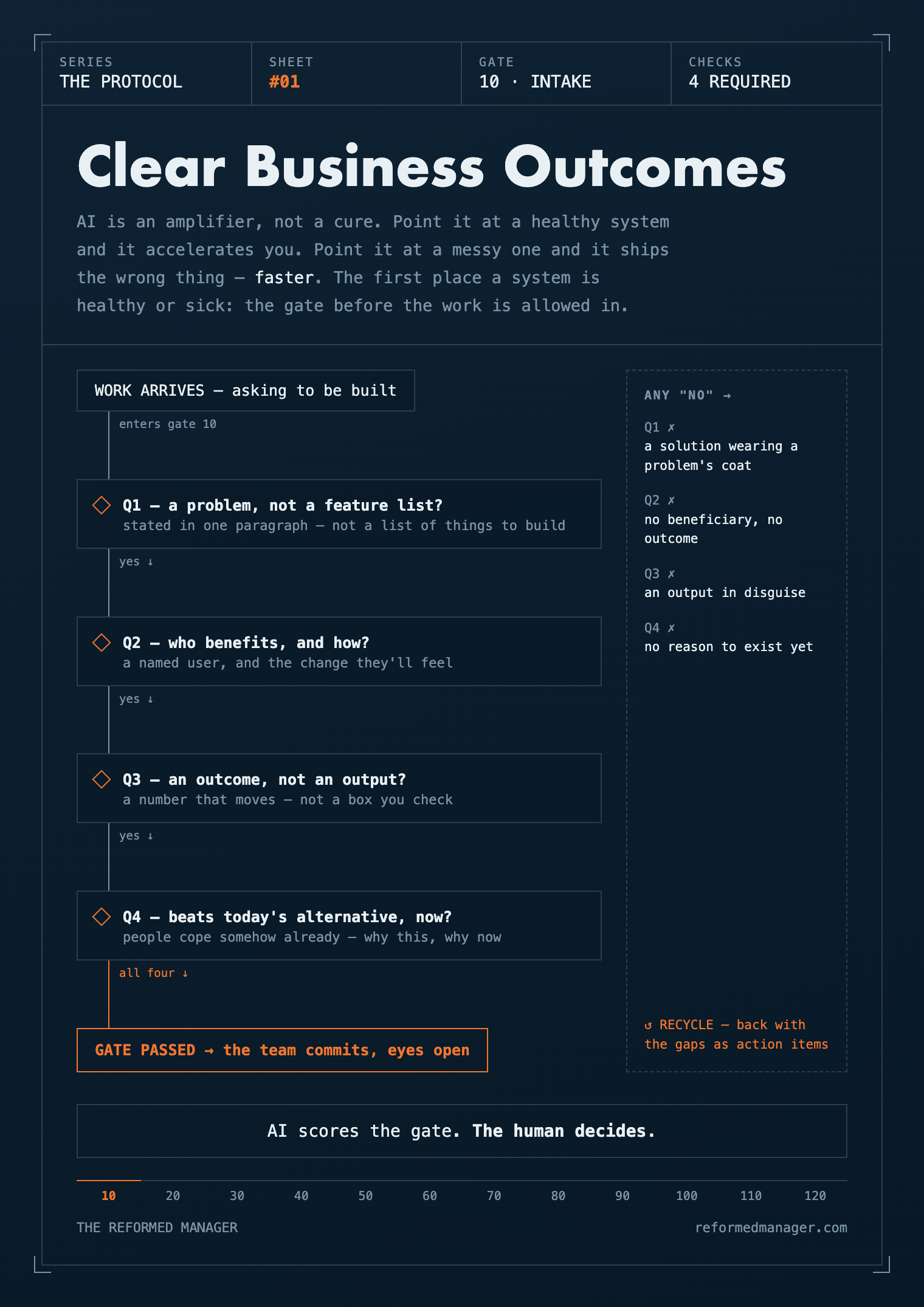
That’s what the first gate is for. In the 12-gate SDLC health system I run, Gate 10 is Intake Accepted — and its whole job is to refuse work that doesn’t yet have a clear business outcome. Not “is the ticket written.” Is there a there, there. Four checks, and most initiatives fail at least one:
- A problem, not a feature list. State it in one paragraph. The test is brutal and clarifying: if your “problem statement” is really a list of things to build, you don’t have a problem yet — you have a solution wearing a problem’s coat. Ask most teams what problem they’re solving and you get the feature list back. That’s the tell.
- Who benefits, and how. Name the user or customer and the change they’ll feel. No beneficiary, no business outcome.
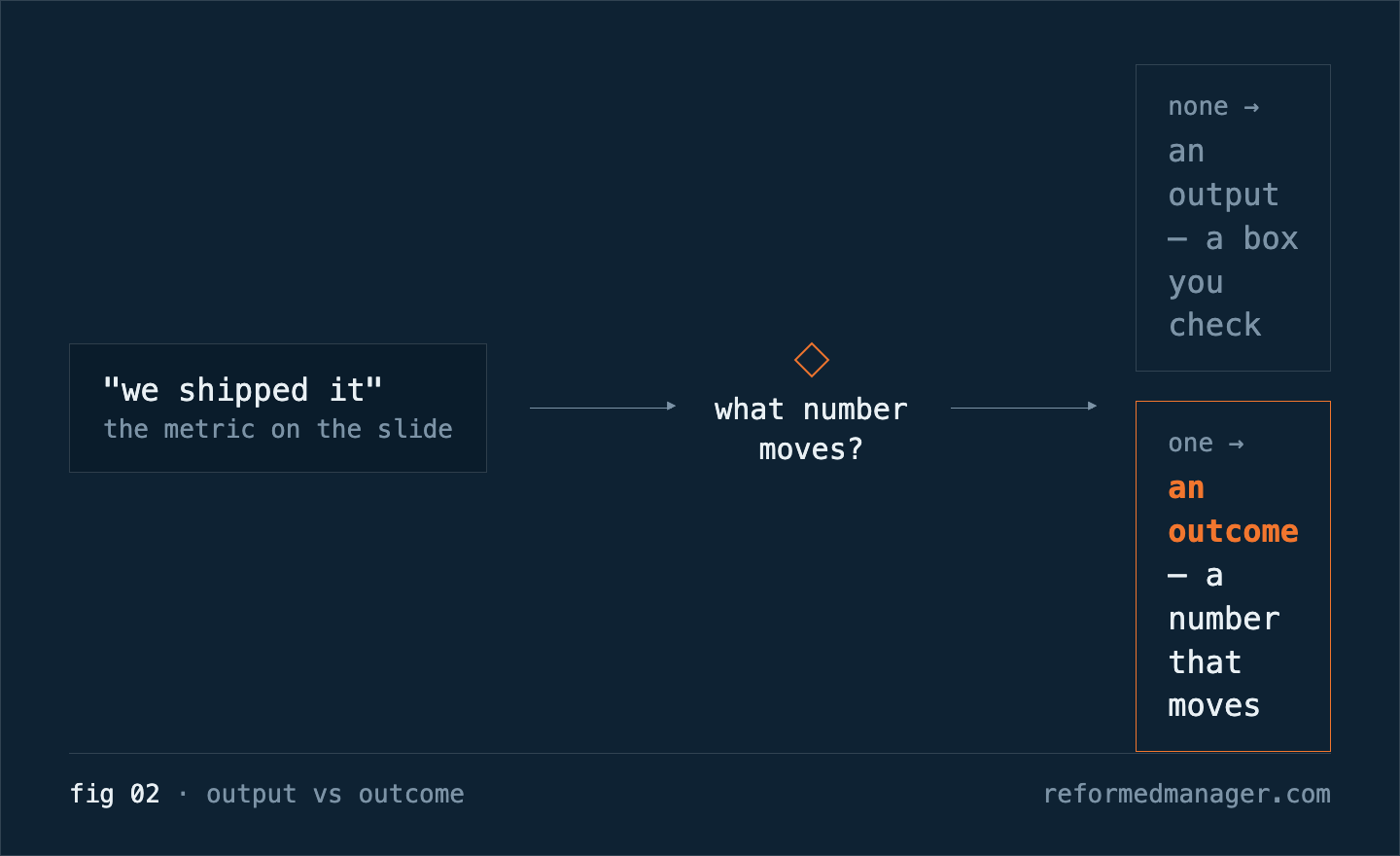
- A success metric that’s an outcome — not an output. “We shipped the Android app” is an output: did-you-do-it, yes or no. An outcome is a number that moves — onboarding drops from thirty days to three hours; support tickets fall a quarter. If your metric is binary, it’s an output in disguise. Fix it here, on the cheap.
- What people do today, and why now. The alternative already exists — a spreadsheet, a workaround, nothing at all. If you can’t say why this beats it and why now, intake isn’t done.
AI will happily generate a beautiful solution to a question nobody asked.
Isn’t this the product manager’s lane?
Here’s the opinion I’ll defend: I want to give my team a holistic view of what they’re doing. People build better when they understand what they’re trying to achieve and who it helps. The business outcome isn’t paperwork — it’s the thing I point to in refinement and say this is why this matters. Strip it out and the team executes tickets in the dark. Keep it in and they catch the gaps you missed.
How do you run the gate without drowning in it?
This is where the augmentation earns its keep — and it’s concrete, not magic. I don’t run Gate 10 by hand. I take those four checks, point an AI at the initiative — the epic, the brief, whatever artifacts exist — and ask it to score each one: problem or feature list? beneficiary named? metric an outcome or an output? It comes back with a clean read and, the part I actually wanted, the gaps phrased as action items I can walk straight to the product manager: no success metric on this one — we need it before the team commits. A gate that used to be a gut feeling becomes a checklist I run in minutes and a conversation I start with evidence.
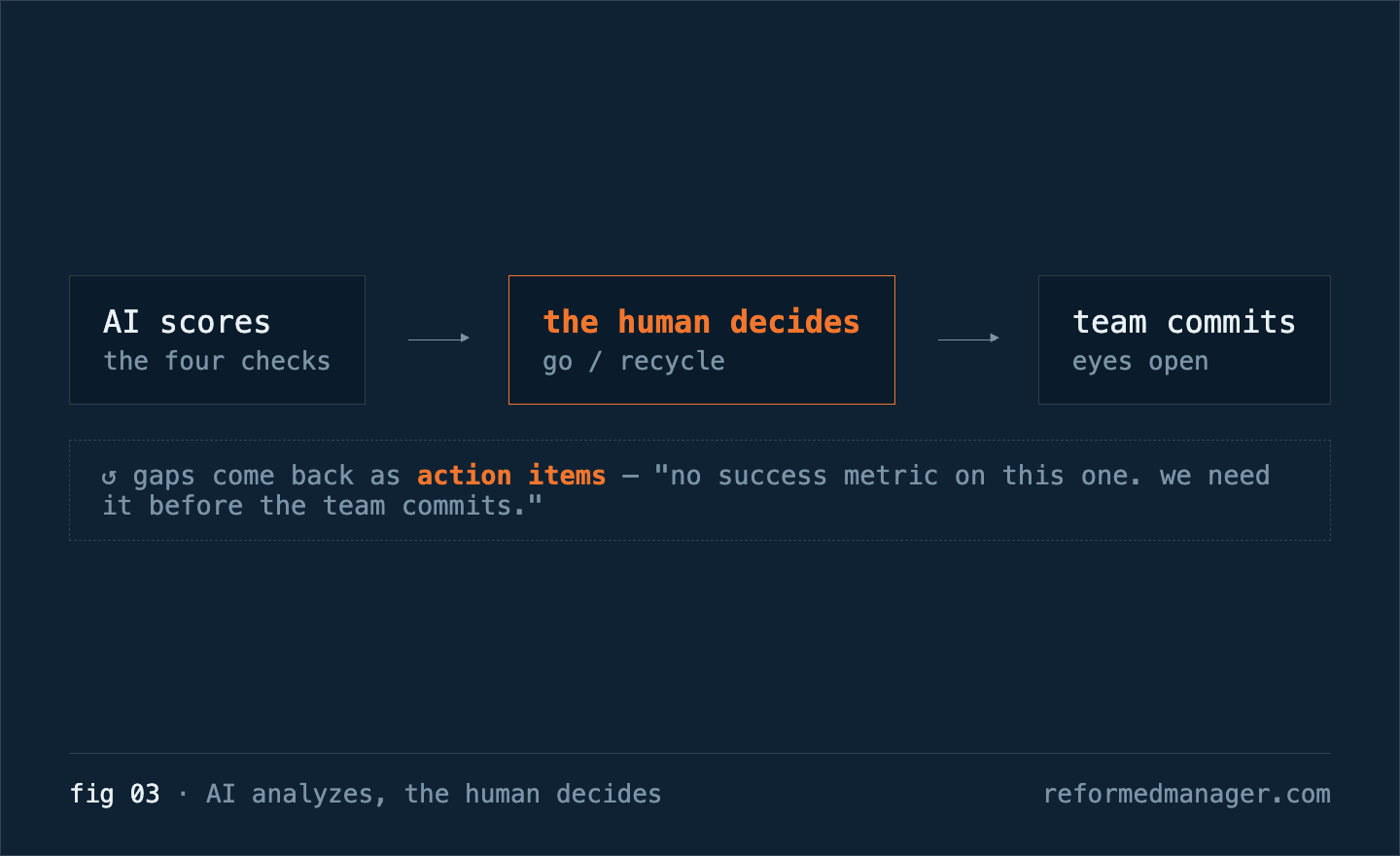
One caveat, load-bearing: keep a grain of salt on everything AI hands you. It’s fluent and confident even when it’s wrong. So AI scores the gate; you make the call. AI analyzes, the human decides — that’s the whole game.
What happens if you skip it?
Run Gate 10 and you’ve spent twenty percent of the effort for eighty percent of the outcome. Skip it and the fuzziness doesn’t vanish — it goes quiet and waits, then resurfaces at the worst moment: late in the sprint as scope creep, or after delivery, when the thing you shipped turns out to solve the wrong problem. Hidden problems don’t age well. They detonate near deadlines.
It’s the choice I keep in front of me: easy choices, hard life; hard choices, easy life. Skipping the gate is the easy choice today and the hard life in three weeks. Forcing the awkward “what does success actually look like?” conversation now is the hard choice today — and the easy life later.
That’s Protocol #1. Gate 20 — Discovery, where that single outcome earns a real opportunity map — is next. Eleven gates to go.